

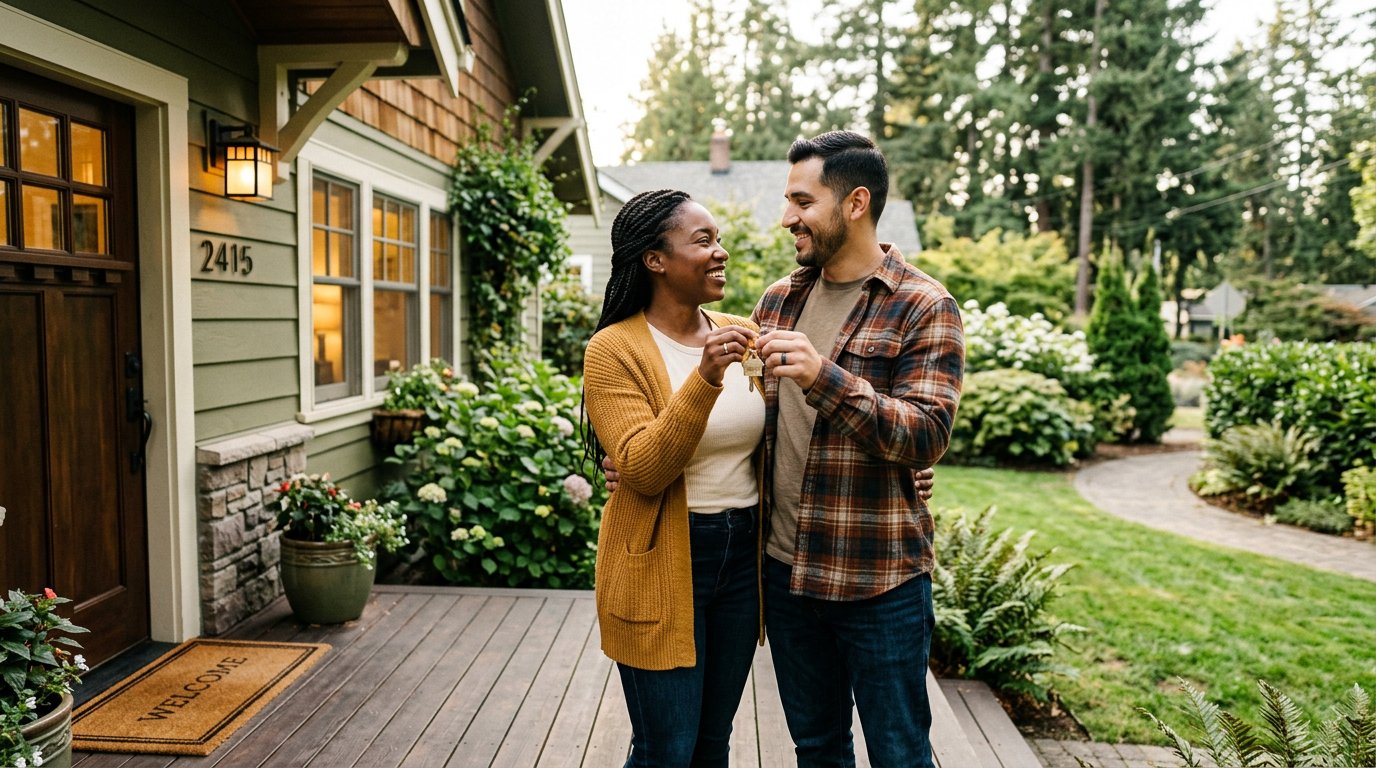
First-Time Home Buyer's Guide to Washington County, Oregon (2026)
Buying your first home is not complicated because the process is hard — it is complicated because nobody explains it in plain English. Here is a step-by-step 2026 walkthrough for first-time buyers in Washington County, from figuring out your real budget through the day you get the keys.
Buying your first home is not complicated because the process is hard — it is complicated because nobody explains it in plain English. Here is a step-by-step 2026 walkthrough for first-time buyers in Washington County, from figuring out your real budget through the day you get the keys.
The short answer
You can realistically buy your first Washington County home in 2026 with 3 to 3.5 percent down on a $500,000 home (roughly $15,000 to $17,500), a credit score of at least 580 to 620 depending on the loan, and about 30 to 45 days from offer accepted to keys in hand. The current market is more balanced than it has been in several years, which gives first-time buyers real negotiating room they did not have during the 2022 peak.
Below is the actual process, in order.
Step 1 — Talk to a local lender before you tour a single home
This is the step almost every first-time buyer wants to skip. Do not skip it. Talking to a lender is free, takes about an hour, and tells you three things you cannot figure out yourself: what price range you actually qualify for, what your real monthly payment would look like at that price, and which loan program fits your situation best.
Common first-time buyer loan options in Oregon:
- Conventional loans — as little as 3 percent down, best rates for buyers with 700+ credit scores.
- FHA loans — 3.5 percent down, more flexible credit requirements (580 minimum for the low down payment).
- VA loans — zero down for eligible veterans and active-duty service members.
- USDA loans — zero down for qualifying rural areas, including parts of Washington County like Banks, Gaston, and outer North Plains.
Ask your lender about the Oregon Bond Residential Loan Program through Oregon Housing and Community Services. It offers two options: Rate Advantage (a lower rate) and Cash Advantage (up to 3 percent of the loan amount toward down payment and closing costs). Income limits and eligibility change periodically — your lender can pull the current rules.
Step 2 — Get pre-approved, not just pre-qualified
Pre-qualified is a rough estimate. Pre-approved means the lender has reviewed your documents and issued a formal letter saying you can borrow up to a specific amount. In this market, sellers ask for a pre-approval letter with every offer. Do not tour homes seriously until you have one.
Step 3 — Meet with an agent and clarify what you actually want
Every first-time buyer walks in with a list of ten things and thinks they need all ten. Almost nobody gets all ten. The point of the first meeting is not to see homes; it is to figure out which three or four things are actually non-negotiable and which are nice-to-haves.
For Washington County in 2026, useful early questions include:
- What is your maximum comfortable monthly payment (not what the lender approved — what you can actually sleep with)?
- Do you want walkability (Orenco Station, downtown Beaverton, downtown Hillsboro), or newer construction (South Hillsboro, Bethany, Sherwood)?
- How important is a specific school assignment? Verify current boundaries — do not rely on old listings.
- What commute do you actually have, and does it drive location more than you think?
Step 4 — Tour homes strategically
The market in Hillsboro and Beaverton right now is workable, not frantic. Recent data from the Hillsboro Herald's July 2026 update showed 97124 median days on market at 56 days and 97123 at 53 days, with roughly 44 to 49 percent of active listings having taken a price reduction.
That means you have time. You do not have to write the same day you tour. You can look at a home twice, walk the neighborhood at different times of day, and think carefully before writing.
Step 5 — Write a real offer
A good first offer includes:
- Your pre-approval letter from Step 1
- Earnest money deposit — typically 1 to 2 percent of the purchase price, held in escrow
- Inspection contingency — do not skip this, ever, on your first home
- Financing contingency — protects you if your loan does not go through
- Reasonable close date — typically 30 to 45 days
In balanced 2026 conditions, you have room to negotiate on price, closing costs, and small repairs. In tight micro-markets like South Hillsboro's newer inventory, offer positioning matters more.
Step 6 — Inspection, appraisal, and final loan approval
After your offer is accepted, expect roughly:
- Days 1 to 10: Home inspection, radon test, sewer scope if needed, negotiate any repair asks with the seller
- Days 10 to 25: Appraisal ordered by your lender, homeowners insurance quoted, final loan underwriting
- Days 25 to 40: Final loan approval, title work completed, closing scheduled
- Day of closing minus 1 or 2: Final walkthrough of the home
- Closing day: Sign the paperwork, wire your down payment and closing costs, get the keys
Closing costs in Oregon typically run 2 to 3 percent of the purchase price. On a $500,000 home that is $10,000 to $15,000. Some of this can be covered by seller concessions or down-payment assistance programs.
Step 7 — The day you get the keys
This part sounds obvious but matters: the day you close, walk into your new home before doing anything else. Confirm keys work, confirm utilities are on in your name, take date-stamped photos of every room. This is the baseline you will compare to if anything breaks in the first thirty days.
The three questions we get asked most
"Should I wait for rates to drop?" Waiting for a perfect rate is a losing game. If a home fits your budget today, buy it today. If rates drop, refinance. If they do not, you already own the home you like.
"How much house can I actually afford?" Not what the lender approved you for. What you can pay every month without stress, factoring in property taxes, insurance, and typical maintenance (budget 1 percent of the home's value per year for repairs).
"What if the market drops after I buy?" Long-term Washington County has been a steady appreciating market anchored by strong employment. Short-term dips happen. If you plan to stay 5+ years, short-term price movement rarely matters — you build equity through monthly principal payments regardless.
What to do next
If you want a real conversation about what you can actually afford in Washington County, which neighborhoods fit your priorities, and which lender to talk to first, that is exactly the kind of conversation we have with first-time buyers every week. There is no pressure, no email drip, and no obligation.
Kent Bounds (Principal Broker, RE/MAX Equity Group) and Kionna Sakhoeun (Broker) work with first-time buyers across Hillsboro, Beaverton, Forest Grove, Tigard, Sherwood, and the broader Portland Metro. Call (503) 784-1065 or reach out through the contact page to start your first-home conversation.
Frequently Asked Questions
How much do I need saved to buy a first home in Washington County?
What credit score do I need to buy a first home?
What Oregon first-time buyer programs exist in 2026?
What is the buying process step by step?
How much are closing costs on a first home in Oregon?
How long does it take to buy a first home?
Should I wait for rates or prices to drop before buying?
Sources & Notes
- Oregon Housing and Community Services — Oregon Bond Residential Loan Program (Rate Advantage / Cash Advantage down payment assistance)
- Freddie Mac Primary Mortgage Market Survey (30-year fixed 6.55%, week of July 16, 2026)
- Hillsboro Herald — Hillsboro Real Estate Update, July 2026 (median list prices and days on market by zip code)
- Giving Group Realty (RMLS-sourced) — Portland Metro July 2026 market trends


More from the blog
Hillsboro & Beaverton Real Estate Market Report — August 2026: Prices, Inventory & Days on Market
Hillsboro medians sit in the low-to-mid $600Ks with 42-56 days on market; Beaverton medians run around $580K with 25-41 DOM. Here is what the current numbers mean if you are buying or selling.
Move-In Ready vs. Fixer-Upper: What's Actually Selling Faster Right Now
Turnkey or a project? An honest local breakdown of which is selling faster in Washington County right now — and how to decide what's right for you.

Mortgage Rates Are Easing — Here's What It Actually Saves You on a Washington County Home
A plain-English look at what today's mortgage rates actually mean for your monthly payment and buying power on a Washington County home.